
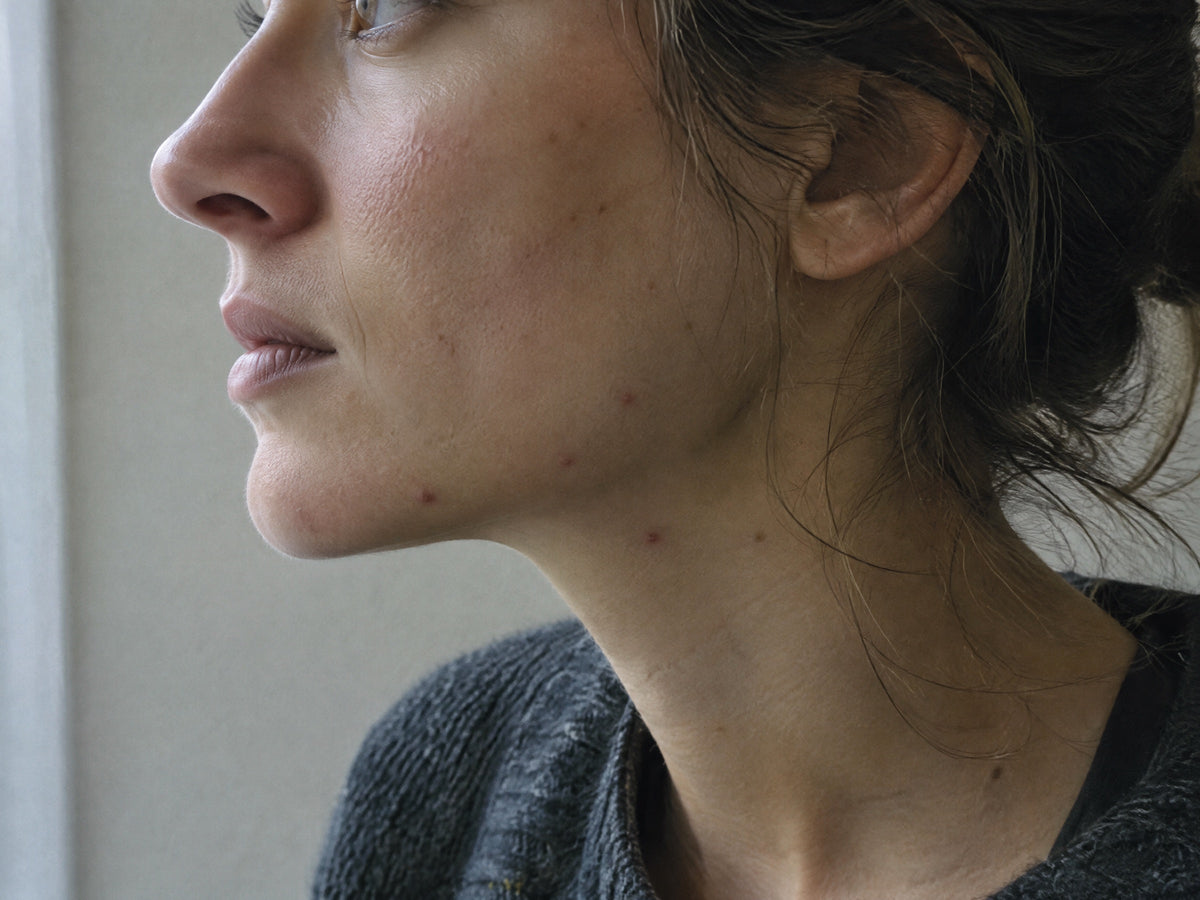
Short answer: androgens are a group of hormones that both men and women produce. The best-known are testosterone and DHT. In your skin, they signal your oil glands to make more oil. More oil means a greater chance of blocked pores, and therefore spots. How much this affects you mainly depends on how sensitive your oil glands are to them.
If you’ve been reading about blemish-prone skin, you’ve probably seen the word ‘androgens’ come up again and again. Alongside hormonal spots, PCOS, the pill and spearmint. But what are androgens? Where do they come from? And why do they affect some people so much more than others? Let’s break it down in plain English, so you can understand what’s happening in your skin.
In short
- Androgens are hormones that both men and women have.
- In your skin, testosterone is converted into DHT, the most potent form.
- Androgens signal your oil glands to produce oil.
- How sensitive your oil glands are makes a big difference. That’s partly inherited.
- Sleep, stress and your cycle affect your androgens.
What are androgens?
Hormones are messengers in your body. They’re made in one place, travel through your blood and send signals somewhere else. Androgens are a group of hormones. Among other things, they’re responsible for changes during puberty, such as body hair and a deeper voice. They also regulate your oil glands.
Androgens are often called ‘male hormones’, but that isn’t quite right. Women produce them too, just in smaller amounts. And women need them as well, including for their bones, muscles and sex drive.
The main androgens
There are several androgens. These are the ones that matter most for your skin:
Androgens and where they come from
- Testosterone
- The best-known
- DHT (dihydrotestosterone)
- The most potent
- DHEA and DHEA-S
- From your adrenal glands
- Androstenedione
- A precursor
Precursors are substances your body can convert into testosterone or DHT.
Men produce testosterone mainly in their testicles. Women produce androgens in their ovaries and, like men, in their adrenal glands: two small glands above your kidneys. The adrenal glands mainly produce DHEA and DHEA-S. These are weak androgens, but your body can convert them into more potent ones.
What androgens do in your skin
Your skin contains oil glands. These are small glands attached to hair follicles that produce sebum: an oily layer that keeps your skin supple and helps protect it. Those oil glands have something like locks that androgens fit into. They’re called receptors. When an androgen binds to one, it signals the oil gland to grow and produce more sebum.
What’s interesting is that your skin plays a part too. It contains an enzyme, a kind of helper, called 5-alpha-reductase. This converts testosterone into DHT. And DHT binds to the receptors on your oil glands even more readily. So your skin makes some of the most potent androgen itself, right where it acts.
More sebum means a greater chance of a pore becoming blocked, along with old skin cells. And a blocked pore is where a spot begins. For a step-by-step explanation, read Spots and your skin from within.
Androgens and your hair
Androgens affect more than just your sebum. They affect your hair too. During puberty, they bring about body hair and, in men, facial hair. But DHT can have the opposite effect on your head. In people who are sensitive to it, hair on the crown and around the temples gradually becomes thinner. This is called androgenetic hair loss.
Here too, it’s mainly about sensitivity and genetics. The hormones are the same, but each hair follicle responds differently. That’s why someone can have a full beard and still develop thinning hair on their head.
Why androgens affect some people more than others
This may be the most important thing to understand. Many people with spots have perfectly normal androgen levels in their blood. Yet they still have blemish-prone skin. How can that be?
The answer is sensitivity. One person’s oil glands react strongly to a normal amount of androgens, while another person’s barely react at all. This depends partly on:
- How many receptors your oil glands have. More receptors mean a stronger response.
- How active the enzyme in your skin is. If your skin makes a lot of DHT, your oil glands get a stronger signal.
- Your genetics. You inherit some of that sensitivity from your parents.
So two people with exactly the same blood test results can have very different skin. It also explains why blood tests often show nothing unusual in people with spots.

When your androgen levels change
Your androgen levels don’t stay the same throughout your life. They change at these times, and you’ll often notice it in your skin:
- Puberty. Your body suddenly starts producing much more androgen. That’s why almost everyone gets spots at this stage.
- Your cycle. In the week before your period, female hormone levels fall while androgen levels stay roughly the same. So androgens have a relatively greater influence.
- Coming off the pill. The regular contraceptive pill suppresses the effects of androgens. When you stop taking it, that effect goes away.
- Menopause. Oestrogen falls faster than androgens, so androgens have more influence again.
- PCOS. With this condition, the ovaries produce more androgens than usual.
You can read more about your cycle, the pill and menopause in Hormonal spots: how your hormones affect your skin.
What else affects your androgens
Alongside the bigger changes, everyday factors play a part too:
- Stress. When you’re stressed, your adrenal glands produce more stress hormones and more DHEA. That’s why many people notice more blemishes during busy periods.
- Sleep. Too little sleep or poor-quality sleep disrupts your hormone rhythms.
- Fast-release sugars. Researchers have found indications that eating a lot of fast-release sugars may stimulate androgen and sebum production through the hormone insulin. The link isn’t fully understood, and it doesn’t apply to everyone.
- Gym products. Anabolic steroids, testosterone and some ‘testosterone boosters’ or DHEA supplements raise your androgen levels, and often your sebum production too.
What a doctor can do
Are your androgen levels genuinely too high, or is your skin very sensitive to them? A doctor may be able to help, for example with the pill mentioned above. There are also medicines that counteract the effects of androgens. You can only get these through your GP or a dermatologist, after a proper assessment.
Not sure whether your androgen levels are too high? Perhaps your skin changed a lot after you came off the pill, or you take sports supplements. Talk to your GP. They can arrange a blood test if needed.
Building blocks for your hormones
Your body makes its own hormones using building blocks from the food you eat. A few of these have a direct role:
Zinc contributes to the maintenance of normal testosterone levels in the blood. Zinc also contributes to the maintenance of normal skin. You can find it in meat, fish, cheese, nuts and wholemeal bread.
Vitamin B5, also known as pantothenic acid, is needed to make and break down your hormones, including androgens. It’s found in small amounts in almost everything you eat.
Then there’s spearmint. Scientists are interested in it because small studies found that testosterone levels fell in women who drank spearmint tea twice a day. Read more in Spearmint and blemish-prone skin: what do we know so far?
Where Clear+ fits in
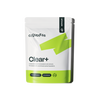
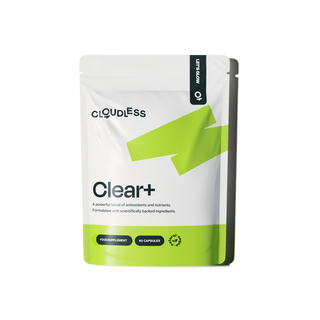
Clear+ brings these three together: zinc, vitamin B5 and spearmint, with 500 mg of vitamin B5 and 200 mg of spearmint extract per day. It also contains vitamin A and six other ingredients. Two capsules a day, with every amount listed on the label. Clear+ is vegan and made in the Netherlands, and Eurofins tests every batch.
Because your androgens are active every day, it’s important to take Clear+ every day too, through your good weeks and your not-so-good ones. See how you feel after around 90 days, then keep taking it if it works for you. Don’t take another supplement containing zinc alongside it, such as a multivitamin. Find out why each ingredient is in Clear+ in What’s in Clear+, and why these amounts?
I’ve tried so many things … I never write reviews, but this really helps. I saw results after just a few weeks.
Joelle K.
More about Clear+
Clear+ at a glance
- Zinc, 500 mg of vitamin B5 and 200 mg of spearmint in one product
- Two capsules a day, with every amount listed on the label
- Skip a delivery or cancel yourself in your account
- 90-day satisfaction guarantee on your first order
Frequently asked questions
What are androgens?
A group of hormones produced by both men and women, including testosterone and DHT. Among other things, they’re responsible for body hair and signal your oil glands to produce sebum.
Do women have androgens too?
Yes. Women produce androgens in their ovaries and adrenal glands, just in smaller amounts than men.
What is DHT?
DHT stands for dihydrotestosterone. It’s the most potent form of testosterone. Your skin makes some of it itself, using an enzyme called 5-alpha-reductase.
Can I get my androgen levels tested?
Yes, your GP can arrange a blood test. They’ll usually only do this if you have other symptoms too, such as irregular periods or excessive hair growth. Many people with spots have normal levels, because skin sensitivity plays a bigger role.
Is oily skin always hormonal?
Not always. Your genetics, the weather, stress and the products you use all play a part. Washing your skin too often or too harshly can actually make it feel oilier. But androgens are one of the main reasons some people’s skin produces more sebum than others.
Can food affect my androgen levels?
To some extent. Your body makes hormones using building blocks from food, such as zinc and vitamin B5. A varied diet with fewer fast-release sugars is a good foundation.
Do testosterone boosters cause spots?
Products that raise your androgen levels, such as anabolic steroids, testosterone and some DHEA supplements, often lead to oilier skin and more spots. If you’re unsure about a sports supplement, ask your GP or pharmacist.
What if I’m not happy with Clear+?
You can get your money back. For your first order, take Clear+ every day for 90 days, then let us know within the next 10 days. Return all the pouches and we’ll refund your purchase price, minus the cost of the return label. You’ll find all the terms in our refund policy.
This article is for general information and isn’t medical advice. If your skin or your cycle is causing you significant problems, see your GP. Clear+ is a food supplement. A food supplement is not a substitute for a varied, balanced diet and a healthy lifestyle.
Sources
- Thuisarts.nl (NHG). I have spots (acne). What can I do? thuisarts.nl
- Thuisarts.nl (NHG). Polycystic ovary syndrome (PCOS). thuisarts.nl
- European Commission. EU Register of nutrition and health claims made on foods. ec.europa.eu
- Grant P. (2010). Spearmint herbal tea has significant anti-androgen effects in polycystic ovarian syndrome. Phytotherapy Research 24(2):186-8. pubmed.ncbi.nlm.nih.gov
 Excellent on Trustpilot